
Northumberland, England
I am so excited, I finally found the track from K drama Typhoon Family that I had been looking for, thanks to Shazam. Yes you got it, it’s A Stranger with Flowers (on a crowded train) by DFAS Music. So good. And apt, because I finally recovered enough from this illness to catch the train to Northumberland for a visit back in August. Northumberland is England’s northern most county and shares a border with Scotland.
Waiting for the train at Platform 8 at Edinburgh Waverley train station, this inquisitive pigeon caught my eye. Amusingly, it appeared to be acting as an avian overseer - watching the trains coming and going in the rain and the boarding passengers. The pigeon would look to the left and the right and peer forward down to the train below. At times a pigeon pal would join in the musings and strut across the metal girders. Here is the pigeon overseer, tiny in the context of the metal beams, and also a quick fun little sketch I did of the pigeon and its pal.
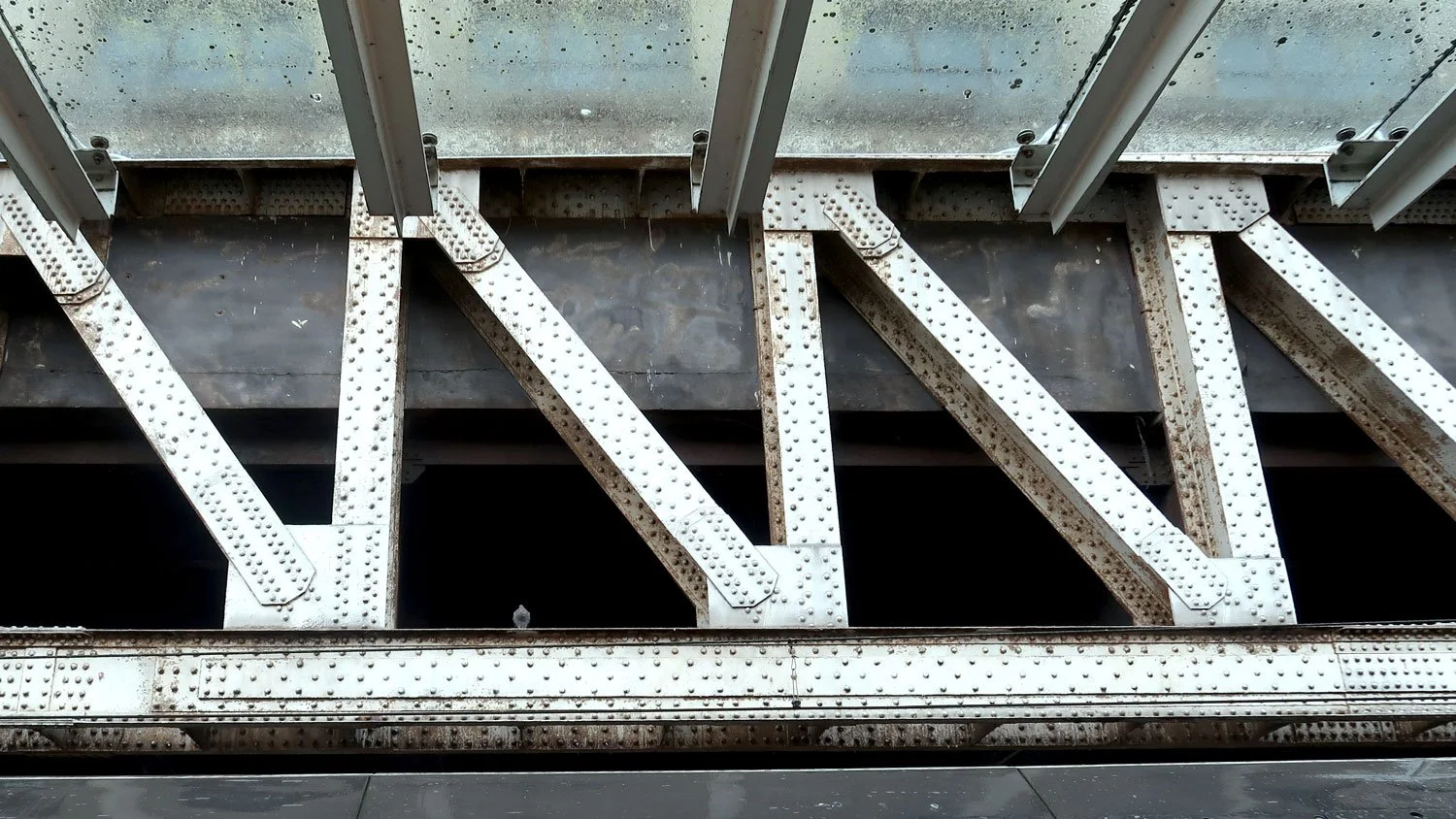
‘Pigeon Overseer’, Edinburgh Waverley Train Station
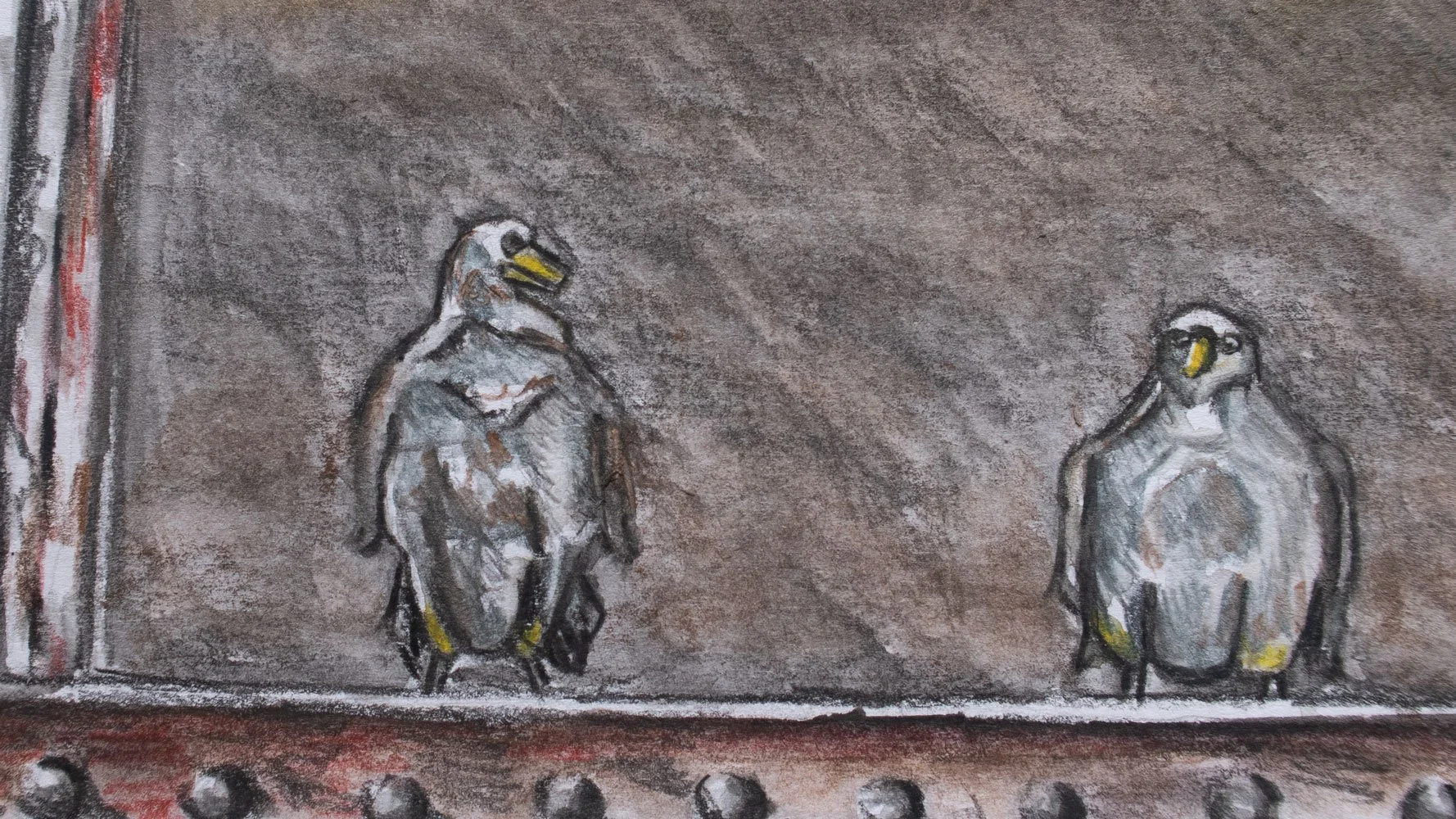
Pigeon Overseer and its Pigeon Pal sketch
After crossing the border, the train travelled through Berwick-upon-Tweed, where the sun had begun to set over golden fields full of both round and square hay bales. There were impressive tetris like stacks of square hay bales in some fields, like art sculptures in their own right, which I managed to photograph on the way back.
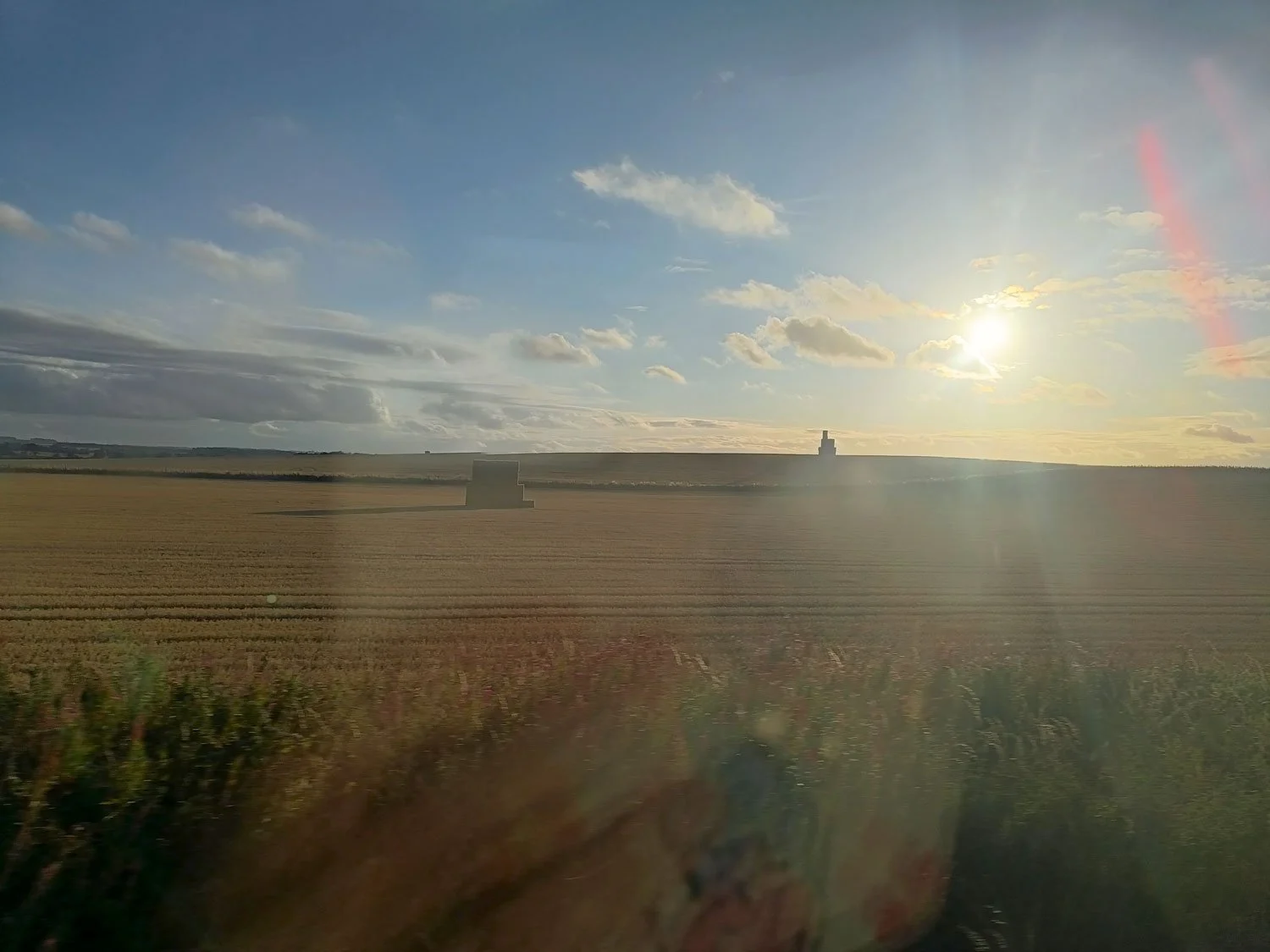
Tetris like hay bale stacks
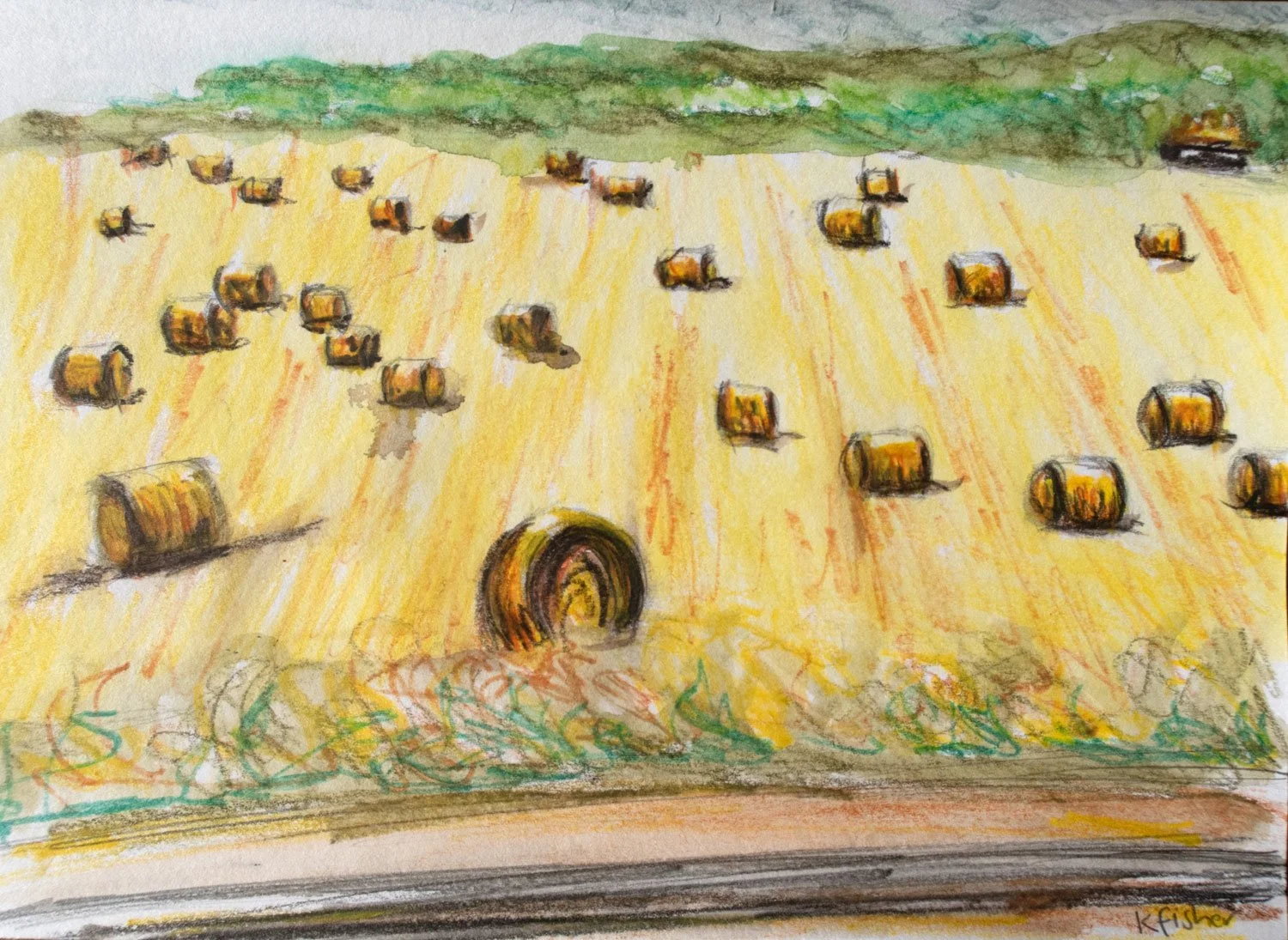
Round hay bale sketch
Seeing the hay bales reminded me of childhood. My Pa used to stack his blue-grey Ford Thames Trader 1964 truck with hay bales, and then my Ma would drive very slowly around the paddocks while Pa would throw off the hay to feed the sheep. The truck had this little sloped engine cover between the bench seat, which had a little dip like a horse back and a handle, so I used to sit on it as a little kid and pretend I was sitting on a horse. I think I called it ‘horsey’, very original to be sure!
After the enjoyable train journey, I arrived to my Northumberland destination. The rain had properly set in by then, but thankfully my friend picked me up from the station and treated me to a lovely home made pumpkin risotto for dinner. Alas, there had been no stranger with flowers, but you never know what might happen in the future…
Seahouses and the Farne Islands
The next day dawned overcast, but no rain. Rain is a good thing when the summer has been hot and dry and the land thirsty, particularly in England where rain is sorely needed at this time. However, we had booked a boat trip to the Farne Islands that day, leaving from the coastal village of Seahouses, so a rainy day wouldn’t have been ideal.
We made it to Seahouses in time for the 1pm boat trip, with my friend navigating the windy roads expertly. A couple of stressy moments included being behind a painfully slow moving motorhome and not being able to overtake and then just as we were about to make it to the harbour, a truck driver had to reverse all the way up the harbour road, meaning my friend had to reverse all that way behind them, while the truck narrowly squeezed past us to back into a side road.
The boat trip, with Billy Shiel’s Boat Trips, went smoothly to Inner Farne, albeit the waves were a bit choppy and gave rise to a bit of seasickness on my part. As I complained about feeling nauseous (obviously wanting sympathy), my friend who is a clever one, told me that saying ‘I am nauseous’ traditionally means I make others feel sick or disgusted (eek!). So it’s more correct to say ‘I am nauseated’, meaning I feel sick myself. Just in case you ever need that wisdom!
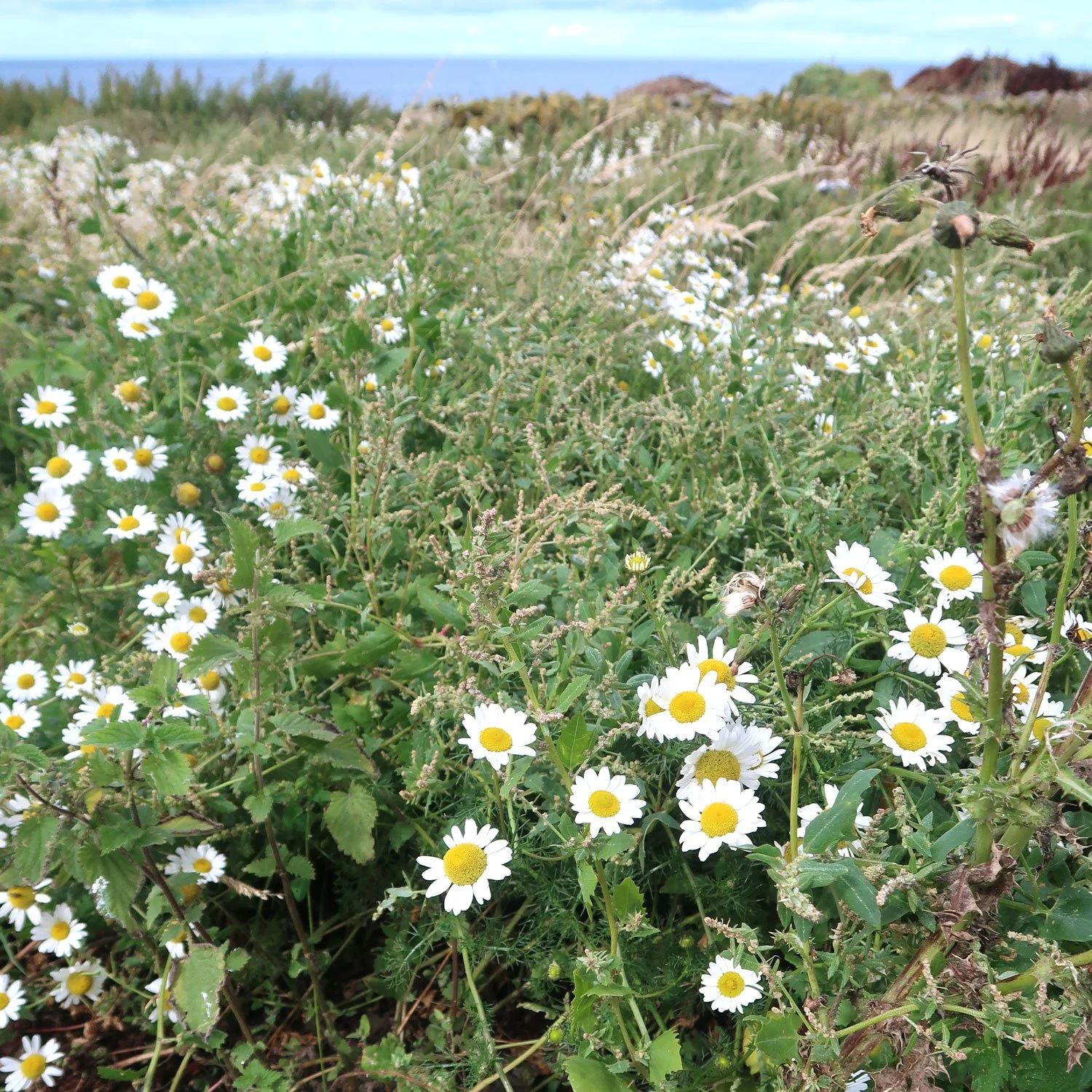
Sea Mayweed, Inner Farne
The landing led up the Inner Farne Island to the RSPB building with information about the seabirds and next to that, the St Cuthbert Chapel. A smidgeon further on stood the building where the RSPB rangers stayed while on the island. One of the rangers gave a brief, but interesting, talk about their work and the counting of seabirds on the island. We walked on the paths around the island, looking out over the ocean. The island also apparently boasts sea campion, however I think the flowers had faded/died by our arrival. The lovely sea mayweed still flowered abundantly and caught my attention.
I thought for this Northumberland travel journal, I would make a few free flowing sketch montages of my trip and just enjoy the process of drawing. I went to the John Brown At Eighty exhibition at The Scottish Gallery back in July and his energetic allotment series inspired me to be a bit more natural about my work. He looks like he enjoyed making the work. This reminds me too of the drawings of Charles Avery. I used to work as a gallery attendant in The Scottish National Portrait Gallery and for a while there was a big drawing of his in an exhibition on the ground floor. I always looked at that drawing and thought, he looks like he really enjoyed drawing that, is that one of the reasons I like it so much?
This is my first montage, which is of Inner Farne landscape, including the abundant sea mayweed. Watercolour pencils are not really my thing, but I thought I would have another crack at them, as they are easy to clean up at the end of the day! I quite liked using the full double spread of the Clairefontaine Paint On Mix Media Multi-Techniques A5 pad.
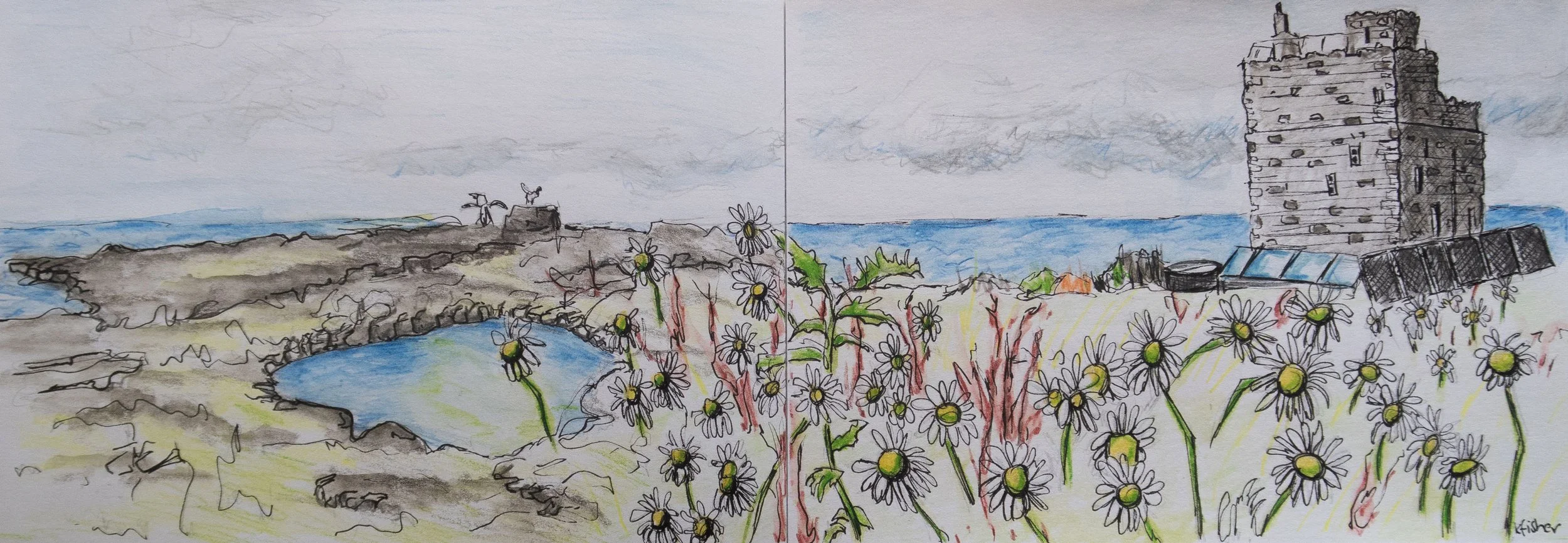
Inner Farne Landscape Montage, ink pen and watercolour pencils
We were disappointed that the puffins and sandwich terns had already left the island, however we did see one puffin flying by itself low across the ocean when we went to the Outer Farne Islands. The puffin burrows were everywhere on the island, some very close to the walkway. One of the RSPB Rangers on the island said that the puffins aren’t really bothered by humans and often like to pose. It would have been amazing to see them that close up, but apparently the best time is May, June and early July. Thankfully, though, the black-legged kittiwakes were still on the island with some fledglings. The fledglings are differentiated from the adults by the black collar around their neck, wing and tail markings and their black bill (adults have a yellow bill). There were a few fledglings on the cliffs near the lighthouse.
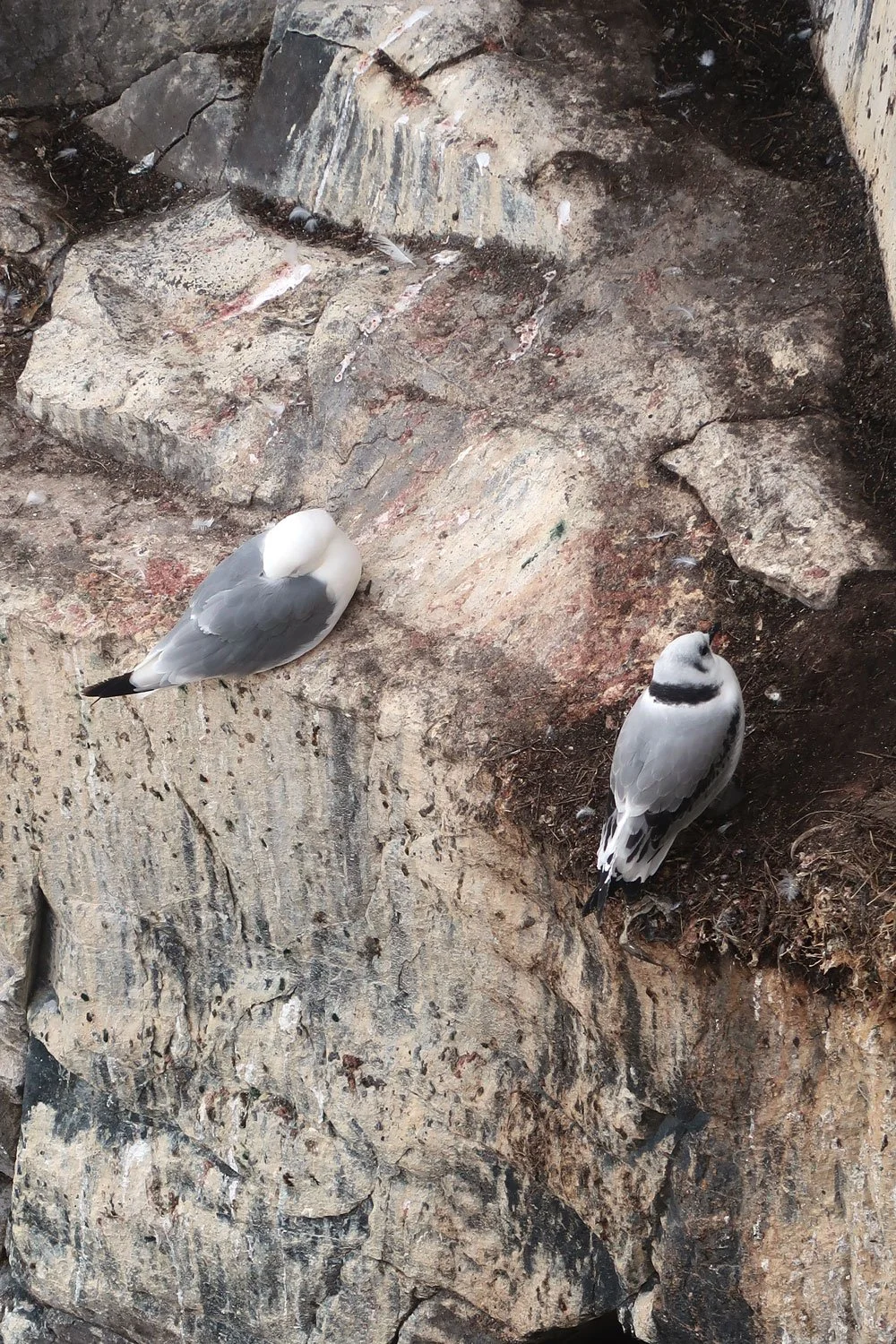
Adult and fledgling kittiwake, Inner Farne
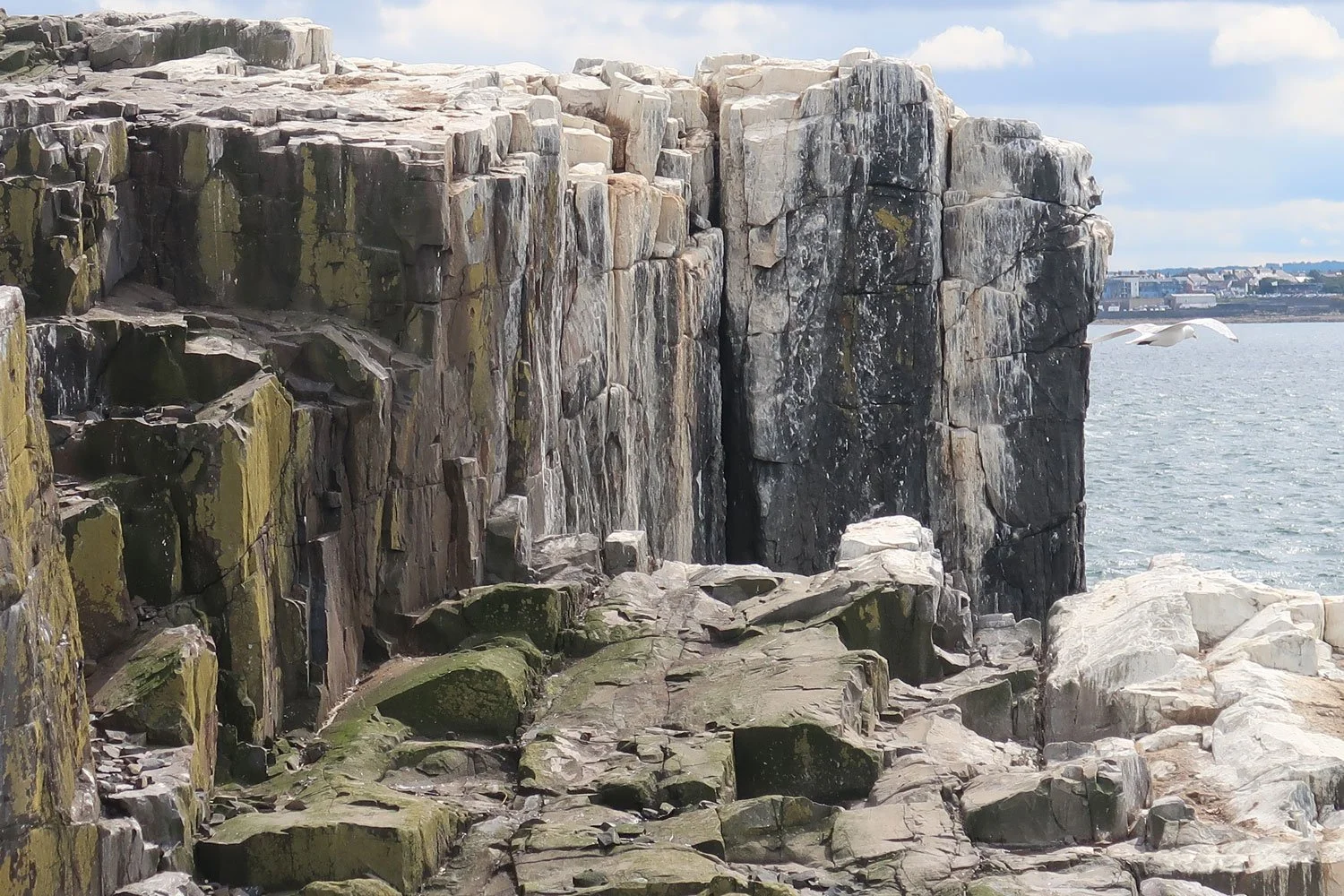
Adult kittiwake flying among cliffs, Inner Farne
I thought the fledgling kittiwakes were really pretty with all their black markings. I love too how a kittiwake turns it head backwards and tucks it into their back feathers to have a little snooze. It looks cosy.
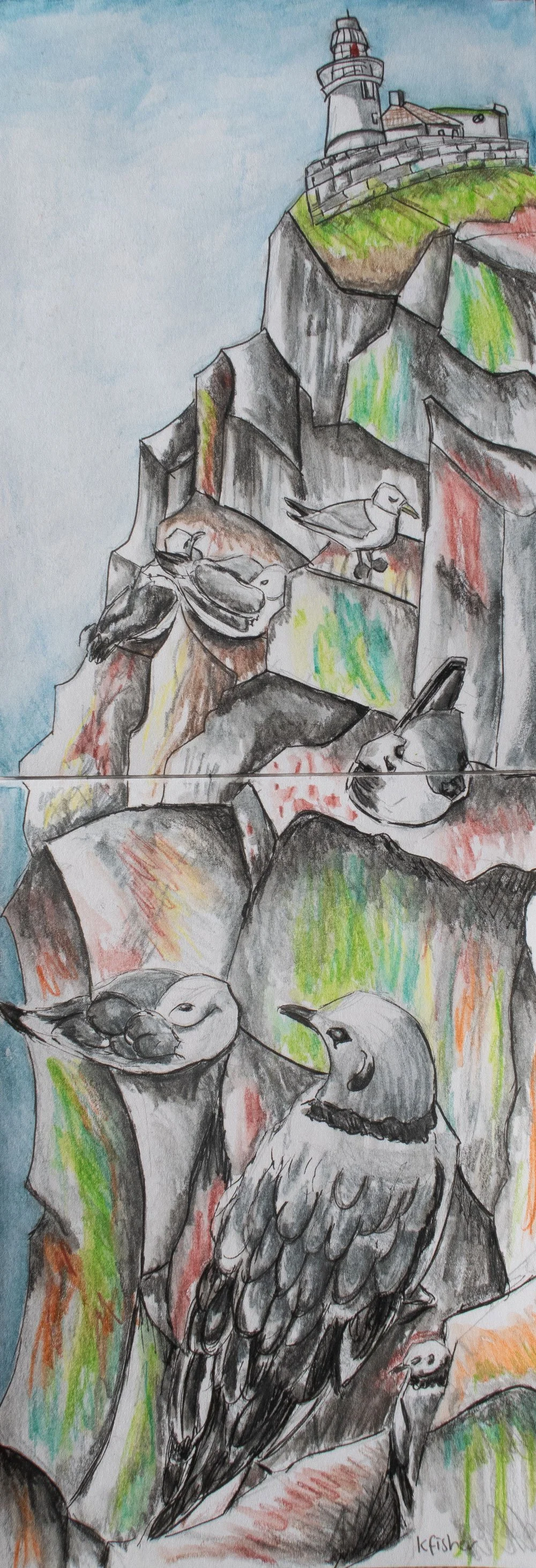
Kittiwakes on Inner Farne, ink pen and watercolour pencils
Very sadly, as with so many species, black-legged kittiwakes have suffered serious declines and are now among the growing list red-listed bird species in the UK per the RSPB. They list a number of threats to these seabirds, including climate change, overfishing, entanglement in fishing gear, development of off shore renewable energy, as well as predators such as rodents. I know that as humans we are trying to find solutions to our need for energy and how best to create solutions that limit the impact on our surroundings, but it seems that the clean energy solutions also have a negative impact on the other creatures on our planet. How do we get the balance right? As a teenager, I remember everything was paper based and records would be stored in physical filing cabinets. Digital based was touted as being the solution to saving the trees on our planet but now digital is causing its own problems, such as high energy and water usage and carbon emissions. How can we be more careful of our data usage and our individual impact on the environment?
While looking at the beautiful kittiwakes, my friend spoke to the RSPB ranger about staying on the island. The island is so small, only the RSPB rangers live there are certain times of the year. St Cuthbert is also recorded as living on the island towards the end of his life in the late 600s AD. Given the size of the island, I am not sure how he managed that, but I bet it would have been an incredible experience during the seabird breeding season. Imagine being the only one to walk amongst all those puffins, sandwich terns, shags and kittiwakes! There is now a St Cuthbert Chapel on the island, originally built in the 14th century. There is a beautiful stained glass window and altar in the chapel, which you can see on the National Trust website.
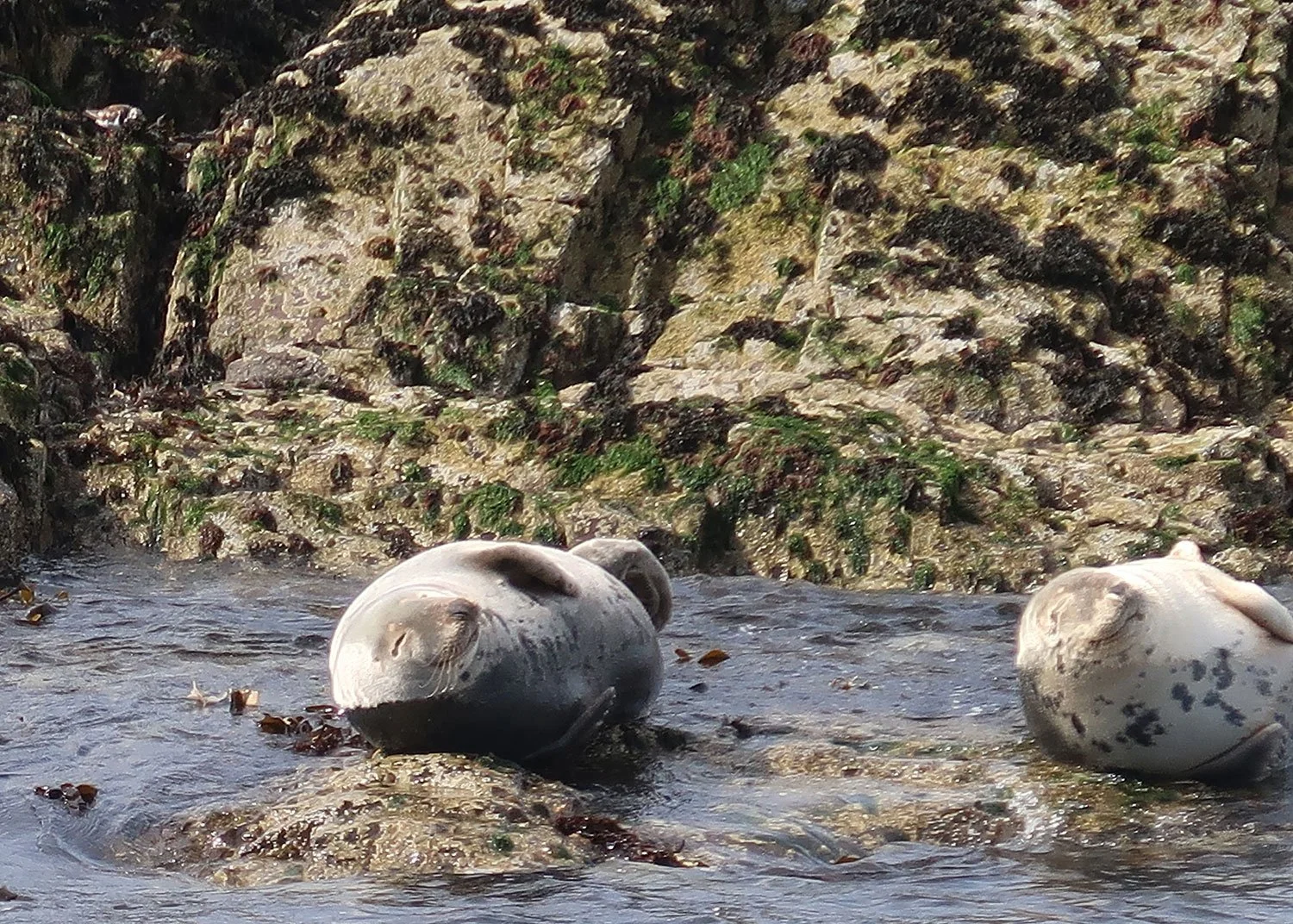
Grey seals, Outer Farne Islands
After leaving the island, the Billy Shiel’s boat tour took us to the Outer Farne Islands. There were seals lazing on the rocks. Some were a very dark colour and some spotted in a way similar to the common seals I had seen on the Isle of Arran. I asked the National Trust person on the boat if these were common seals due to the markings. He replied that they were grey seals and explained that when the seals were wet they were darker but then as they got dry you could see all their different markings - how interesting! We got to have quite a good look. They are so wonderful. I adore their smiling faces. If you read my travel journal on the Isle of Arran, I wrote about common seals. I understand some of the key differences between common seals and grey seals (per this Discover Wildlife article which has gorgeous photos) are that common seals are smaller, have a concave head, shorter muzzle similar to a dog and nostrils that are v-shaped and meet at the bottom; whereas grey seals have more of a flat head, ‘roman nose’ and elongated muzzle and parallel nostrils that do not meet.
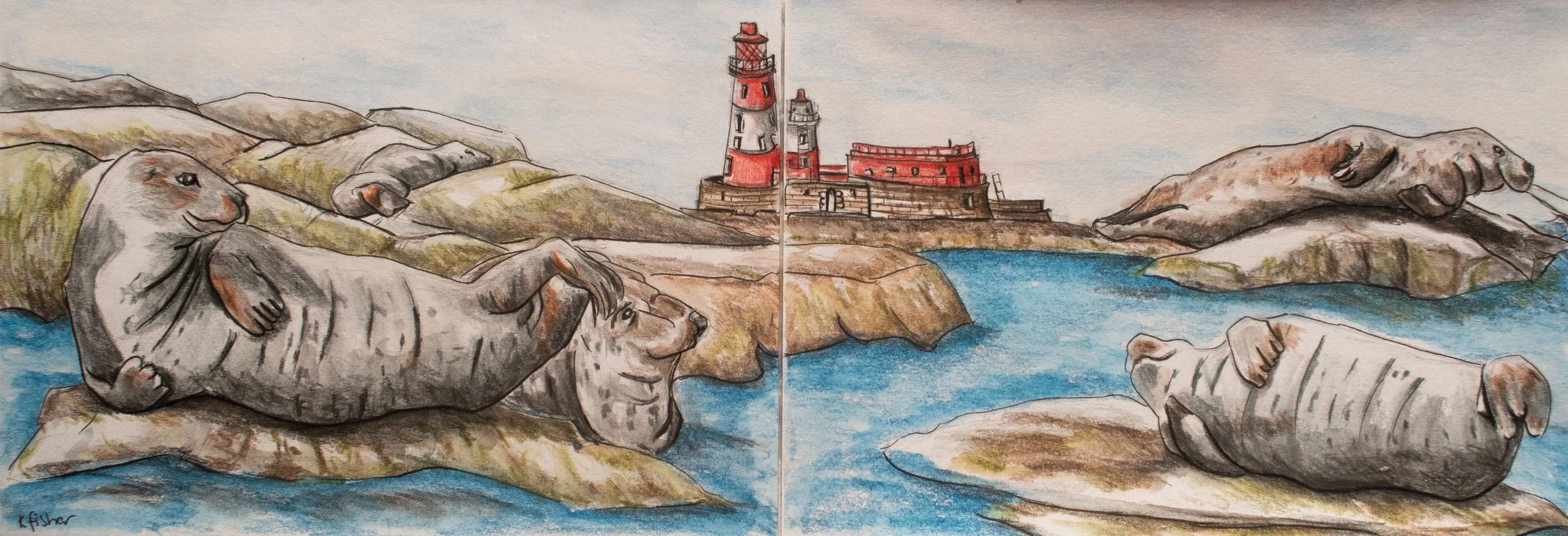
Outer Farne Islands Grey Seals Montage, ink pen and watercolour pencils
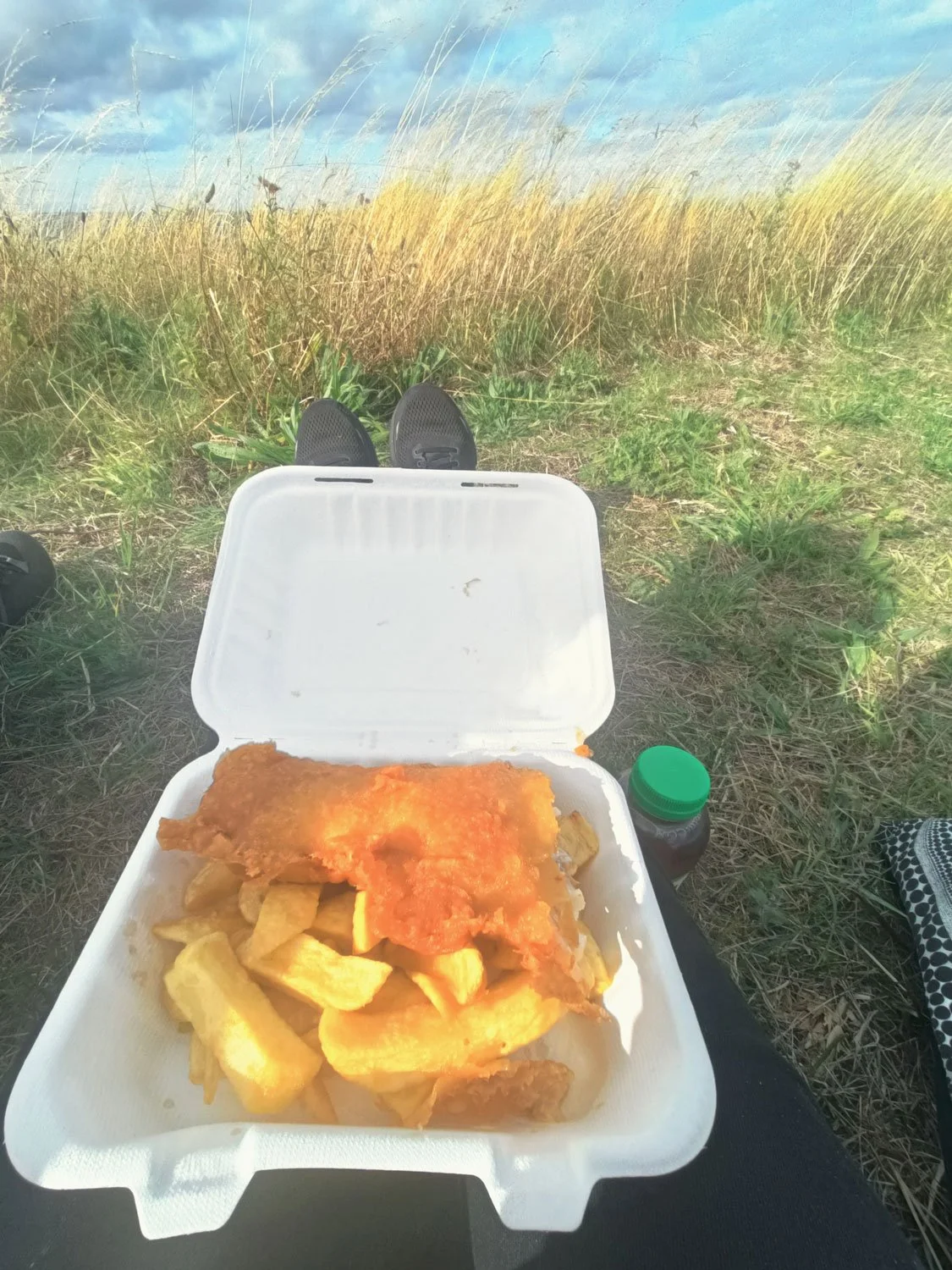
Enjoying supper out in the sea air
Grey seals are a good news story in the UK. Per The Wildlife Trusts ‘Despite numbers dropping to only 500 in the early 20th century, it's estimated that there are now more than 120,000 grey seals in Britain’. However, threats to these lovely creatures still exist, including entanglement in marine litter and fishing gear. The Wildlife Trusts suggests ‘participating in a beach clean or picking up and safely dispose of any rope, strapping or net next time you're at the beach’.
After the boat trip, we enjoyed walking around the lovely artsy shops and then went to Hook Fish & Chips in Seahouses. A whole haddock and chips individually was a bit much for us, so they kindly gave us half portions. It would have been a bit of a trek to make it to the beautiful beach at Bamburgh Castle, so we settled for a grassy patch on the outskirts of Seahouses overlooking the sea.
Wallington Estate
The next day we visited Wallington Estate, which has been owned by the National Trust since the Trevelyan family donated it in the 1940s. What a gorgeous estate! The decorative plasterwork in the drawing room of Wallington house was exquisite. Speaking to one of the National Trust staff, the plastering cost £59 back in the 1700s. I bet you wouldn’t get a room like that now for £59!
Wowed as I was by the Drawing Room, I wasn’t prepared for the absolutely stunning Central Hall. Musicians played traditional folk music in the hall, on the violin, bagpipe and guitar. The hall walls are painted with the scenes capturing 2,000 years of local history, with the main murals having been painted by Pre-Raphaelite artist William Bell Scott (per National Trust website). The pillars are adorned with gorgeous paintings flora and fauna, one of which according to the Victorianweb.org was painted by Pauline Trevelyn herself.
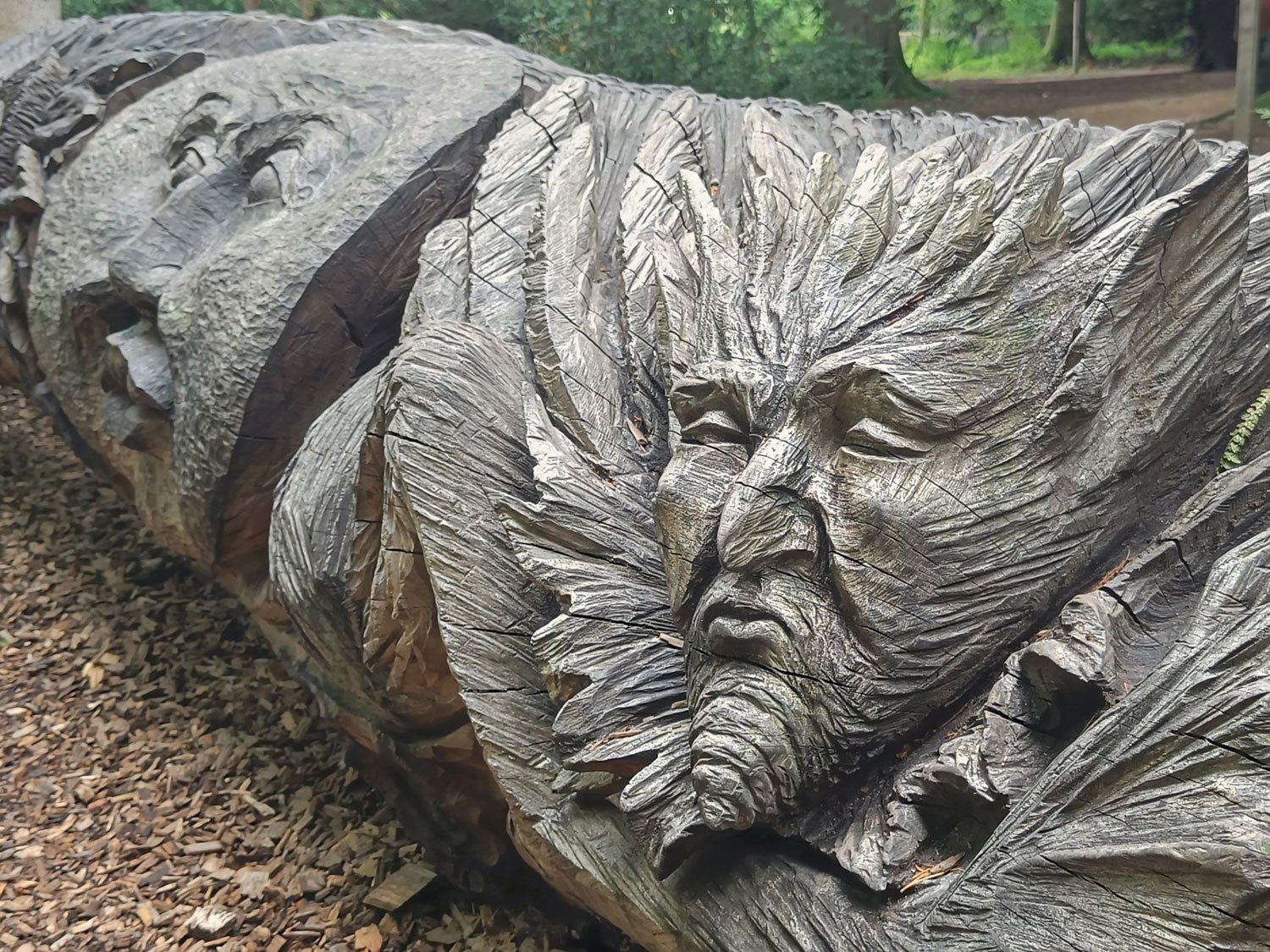
Elementree, by artist Tommy Craggs
Walking along to the walled garden, there were contemporary artworks situated along the path. I absolutely love the elementree that has been carved by contemporary sculptor Tommy Craggs from a fallen oak tree (you can read more about it in this BBC article). I particularly liked the carved faces that look to represent sun and moon and the different carving techniques he appears to have used to bring out the different textures, marks and colours of the wood. I have had a look at Tommy Craggs’ website and think his work is mind-blowing.
A little further on from elementree, stands an incredible woven willow snow drop sculpture by Yeoman basket maker Eddie Glew. I enjoyed standing under the big petals and looking up at all the intricate weaving.
Further along, we passed a pond where ducks were paddling. Later on that day, they were all lined up in a row. I had never really considered where the expression to ‘get your ducks in a row’ may have come from, until this visual display presented itself before me.
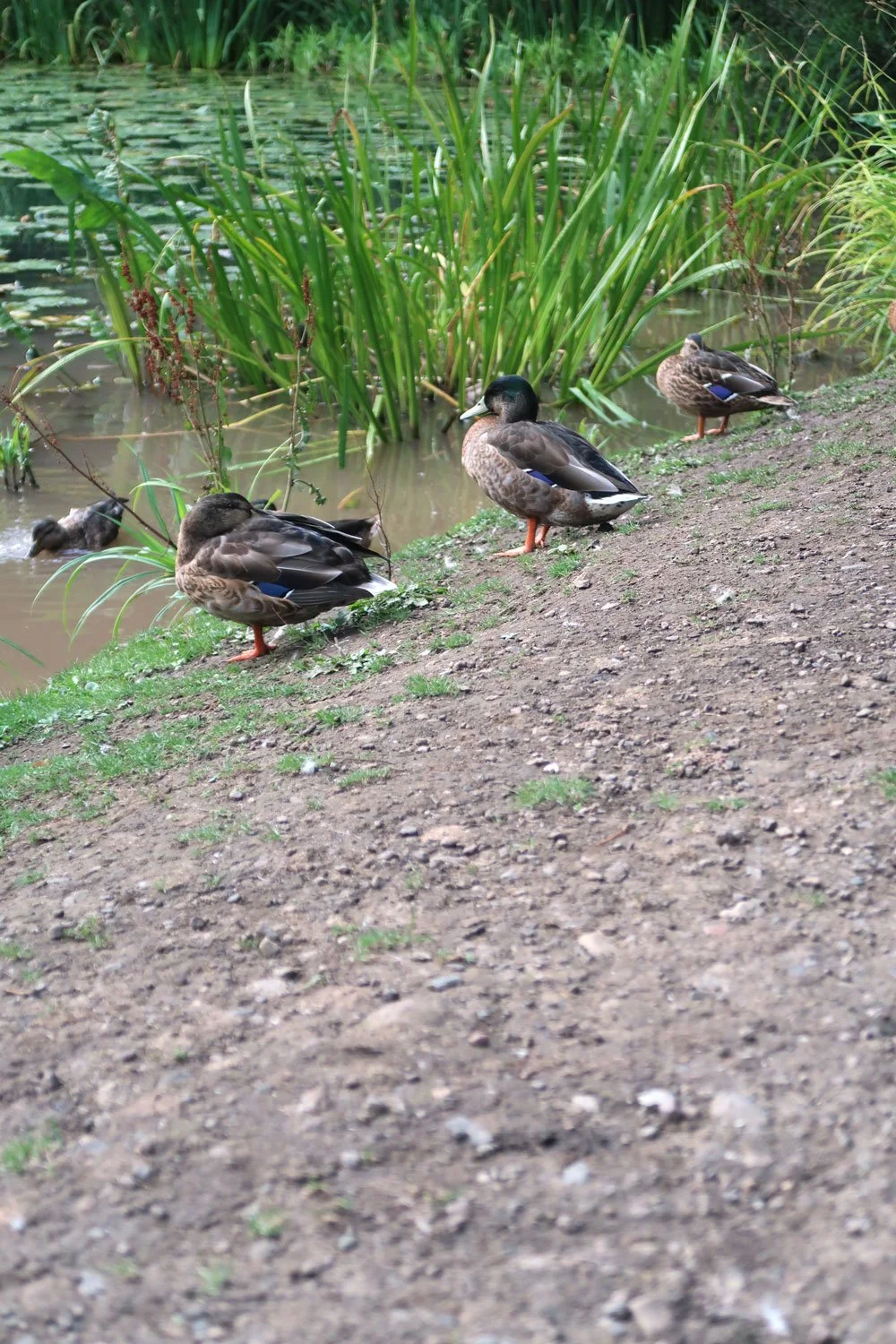
Mallard ducks, with male dressed in eclipse plumage
I thought it strange that all the ducks lined up appeared to be female mallard ducks. That was until I did some research and learnt that male mallard ducks moult their bright colours after the breeding season. These feathers are then replaced by what is called eclipse plumage during July to August, when the males will look more like the females. During this time, the obvious difference then becomes the male’s yellow beak, while the female has an orange bill with black markings. After learning this, I took a closer look at the photos I had taken and yes there was a male mallard in the duck row, with his yellow beak and very faint green on his head. I have always liked mallard ducks and have been drawn to them since I studied at Edinburgh College of Art. One year I hand-made a book called Letters to the North which included my watercolour paintings of mallard ducks. I don’t think it was particularly successful including the text the way I did, but if I don’t try new things, how will I learn how to be a more inventive artist? I quite like the sensitivity of the way I painted though.
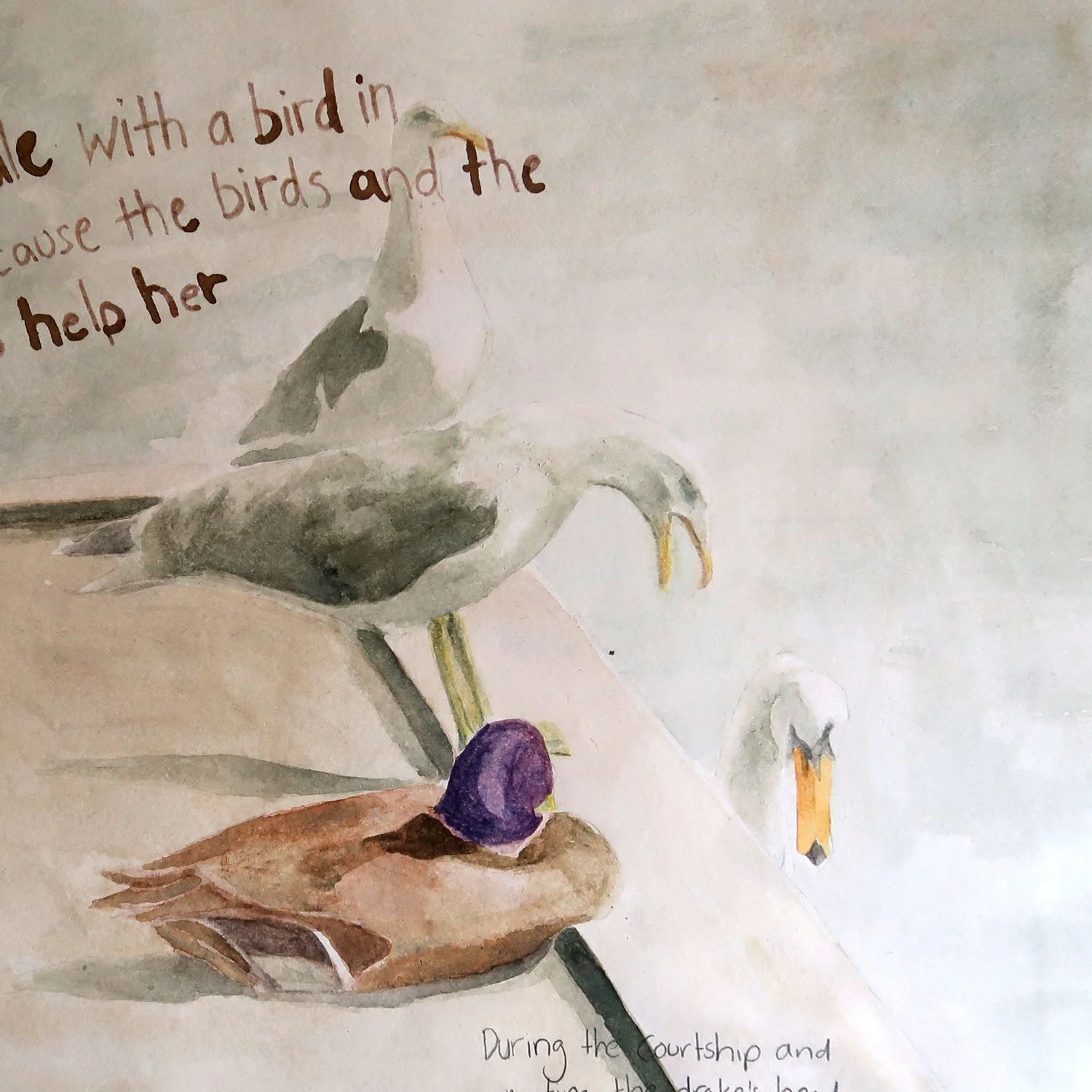
Mallard with seagulls and swan, watercolour
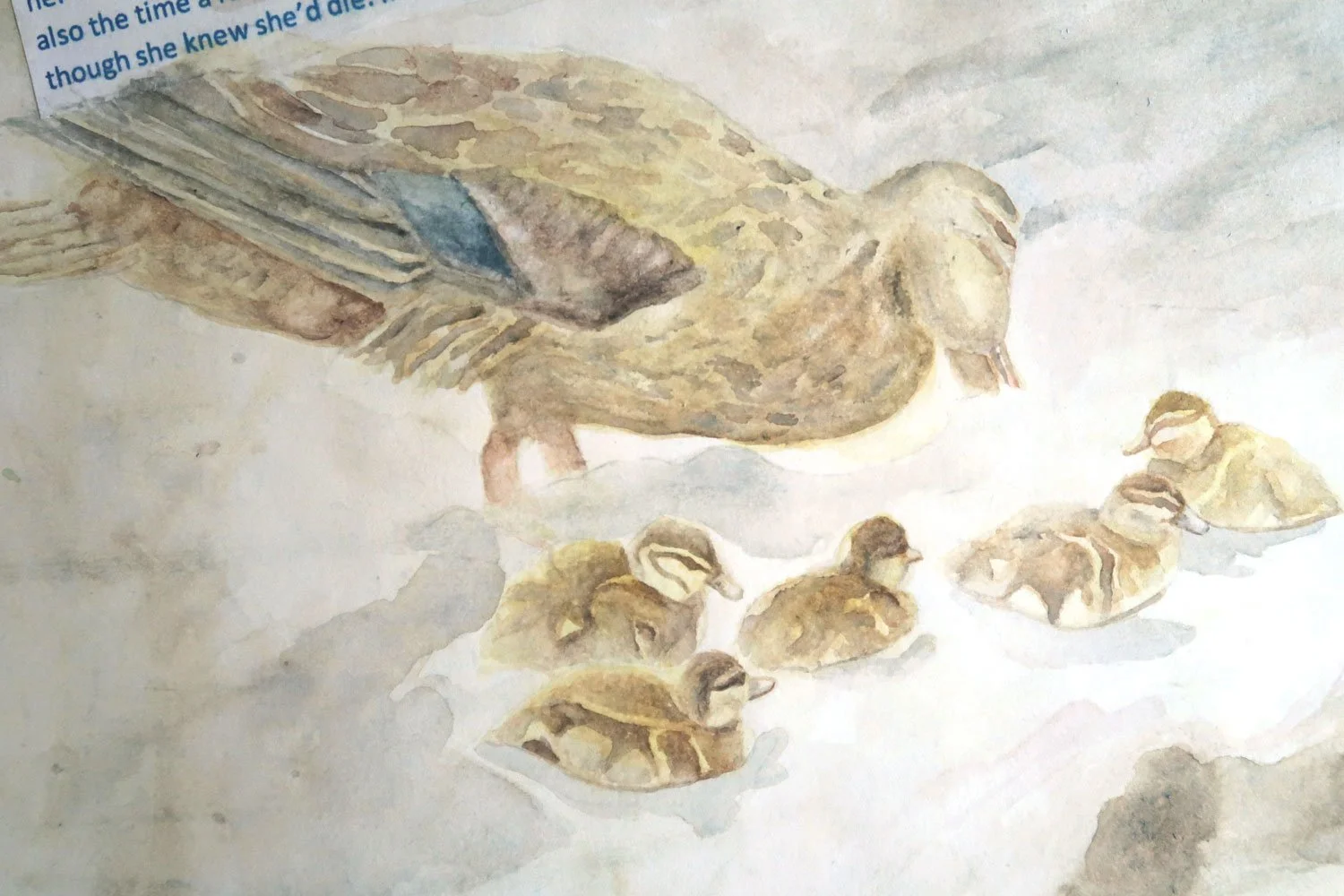
Mallard and ducklings, watercolour
It is shocking for me to now find out the mallards in the UK are now on the amber list (of moderate concern). Another not great news story. I understand the University of Essex is researching the decline and are calling for Duckling Detectives, as 'scientists believe poor survival rates among ducklings could be one possible cause’.
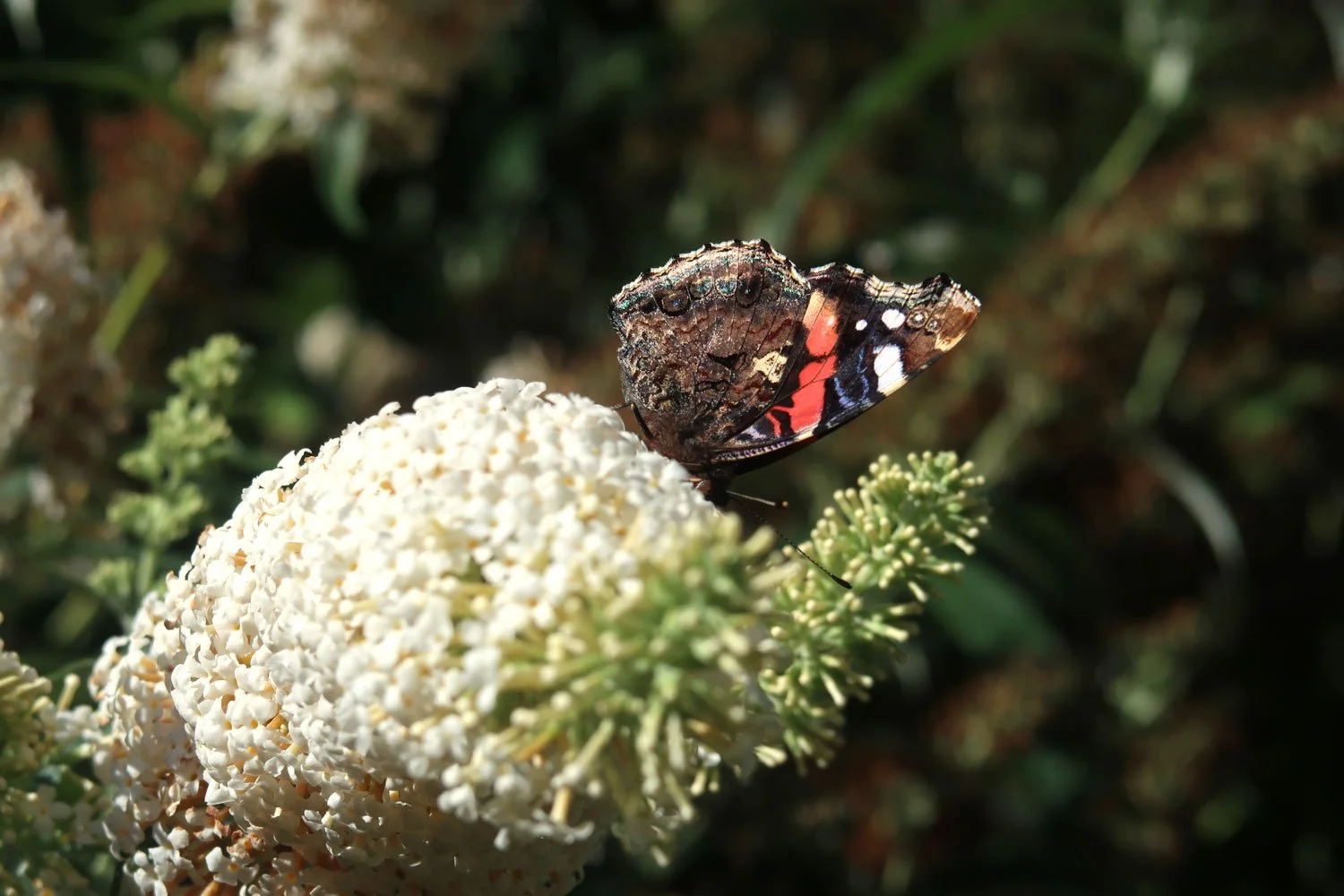
Red admiral butterfly on a white buddleia
We found the walled garden entrance just behind the ducks in a row. The sun shone as we walked along the garden paths. We came across a whole host of butterflies perching on the purple and white flowering buddleias. There were a mix of small tortoiseshell, red admiral and painted lady butterflies. Good news is that all these butterflies are listed as ‘least concern’ on the GB Red list. Not so good news is that the numbers of the small tortoiseshell, which used to be one of the most common butterflies in the UK, have dropped significantly over recent decades per the Butterfly Conservation. Looking at the butterflies, some key differences appear to be that the small tortoiseshell butterfly has blue spots on wingtips; the painted lady is primarily orange, black and white and the red admiral is a black, red and white. However, I took this close up photo of a red admiral and look at the incredibly stunning colours and patterns on its wings. Again, mind-blown. So amazing.
Here is my montage sketch of mallard ducks, butterflies and buddleias.
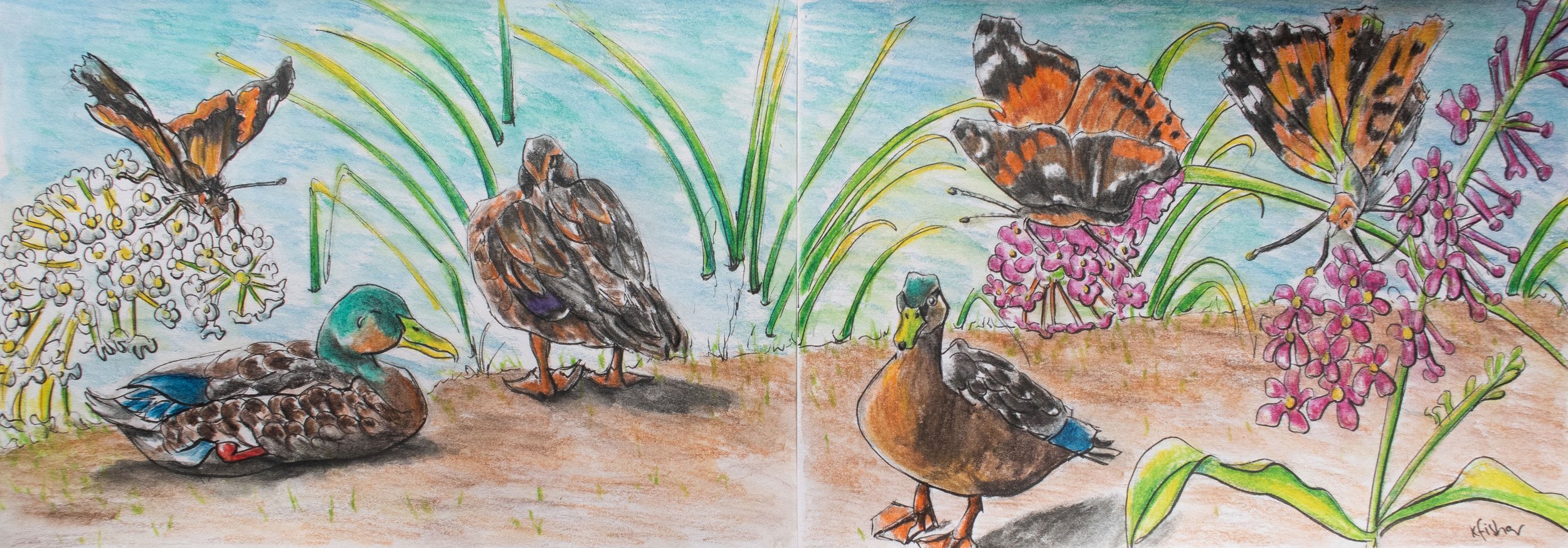
Ducks, Butterflies and Buddleias Montage, ink pen and watercolour pencils
Corbridge Roman Town and Hexham
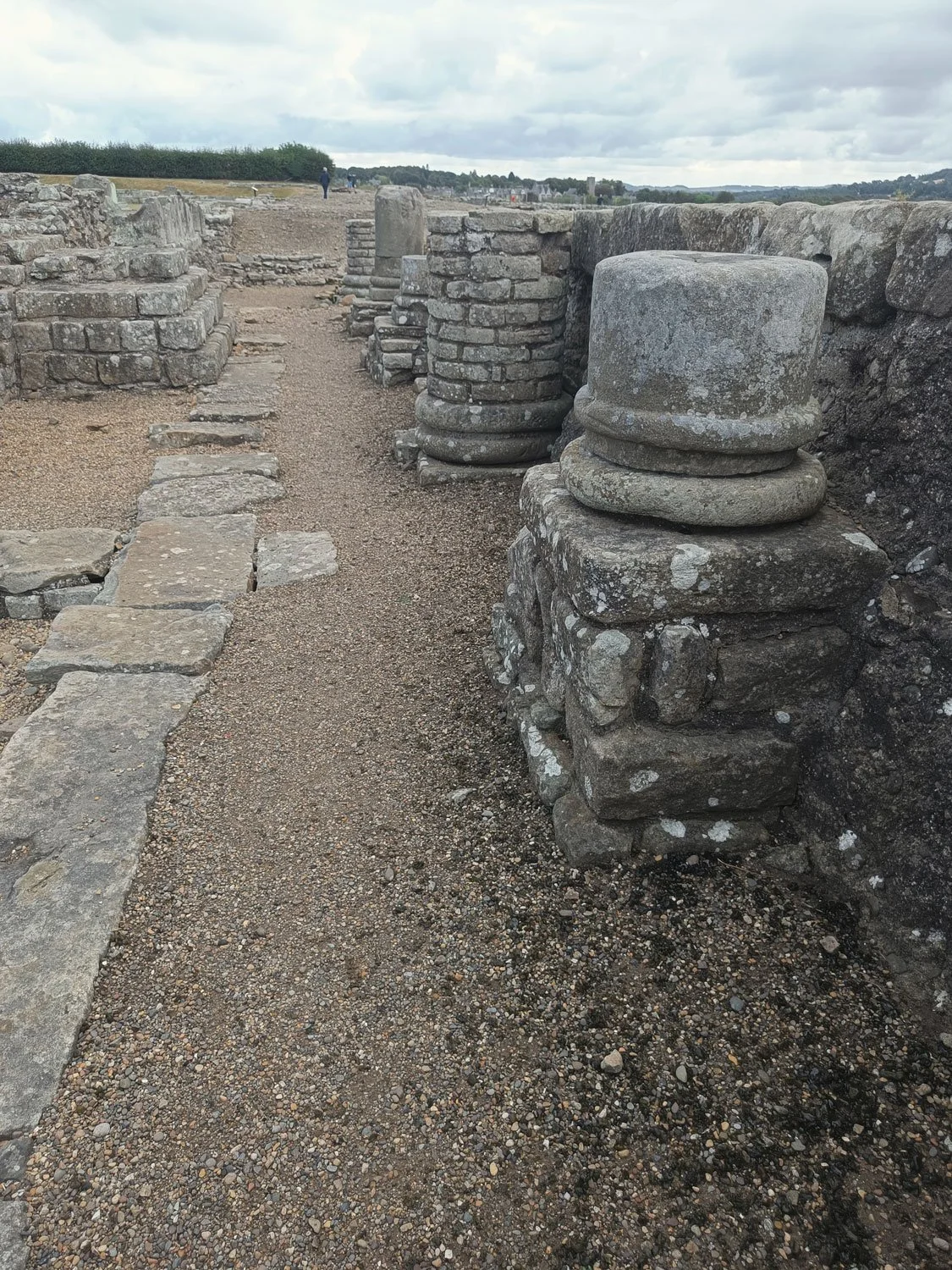
Pillars at Corbridge Roman Town
On my last day in Northumberland, we walked along the Tyne River, past a few brown bunnies chomping on grass in somebody’s back garden and onwards towards the ruins of the Corbridge Roman Town. In early AD, Northumberland was absorbed into the Roman empire.
I found the museum next to the ruins very informative and enjoyed seeing the stone carvings and ceramics from the daily lives of ancient Romans.
A beautiful and touching epitaph on a gravestone carved with an image in bas-relief of a young girl holding a ball read Tombstone of Vellibia Ertola, who “lived most happily for four years and six days”, assumed to be by her father.
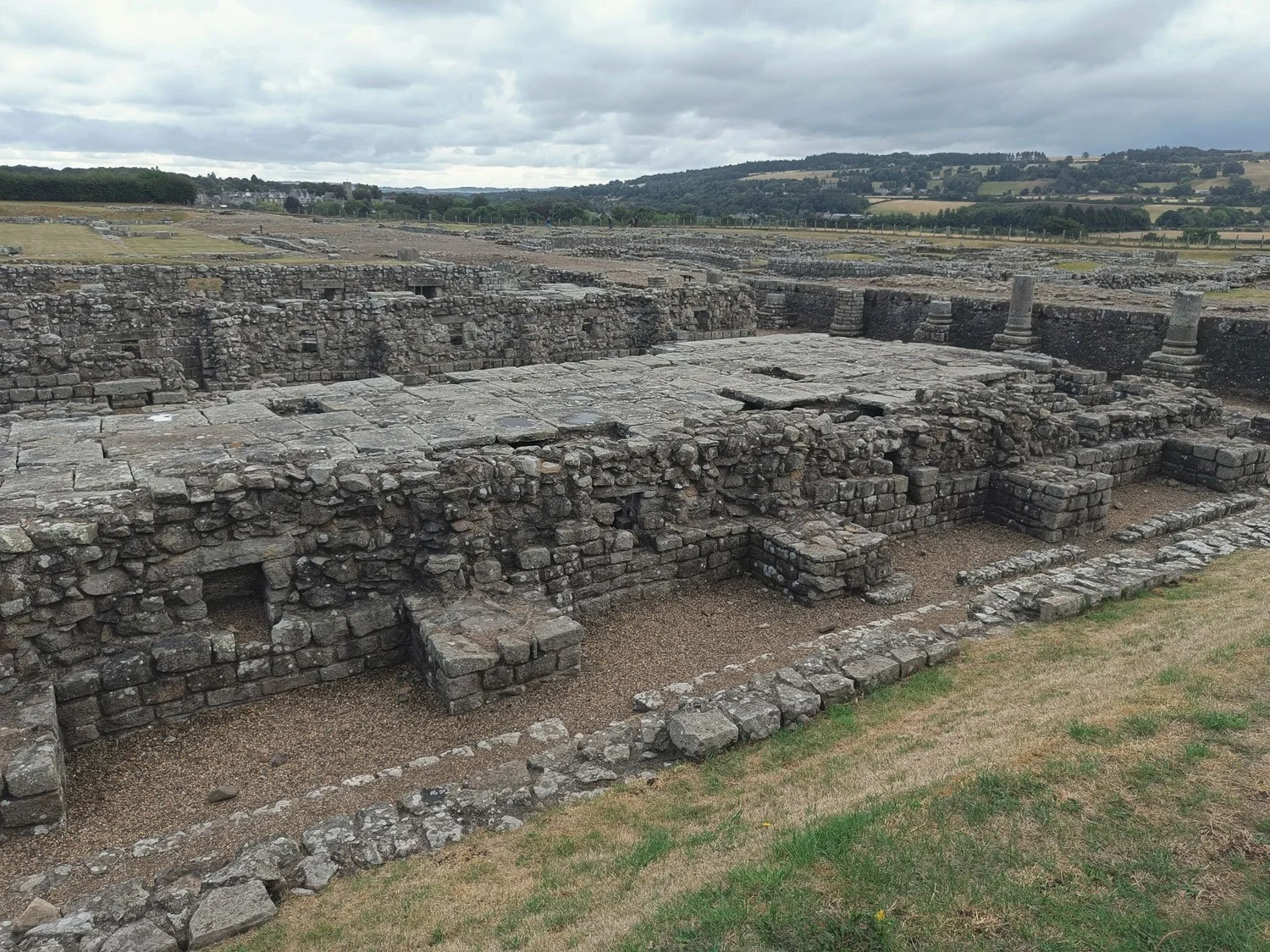
Corbridge Roman Town ruins
Also in the museum, stood a tombstone replica (of which I saw the original later at Hexham Abbey) of a young Roman standard bearer, Flavinus, riding his horse with his boot kicking a naked barbarian on the ground. I admit I found the image quite disturbing. You can see a video of the tombstone on the Hexham Abbey website.
Nothing much really has changed in town layouts has it? We walked around the ruins of the Corbridge Roman Town Main Street, smaller streets and paths. My friend and I both liked the ancient columns and would be partial to have our own if we had mansions.
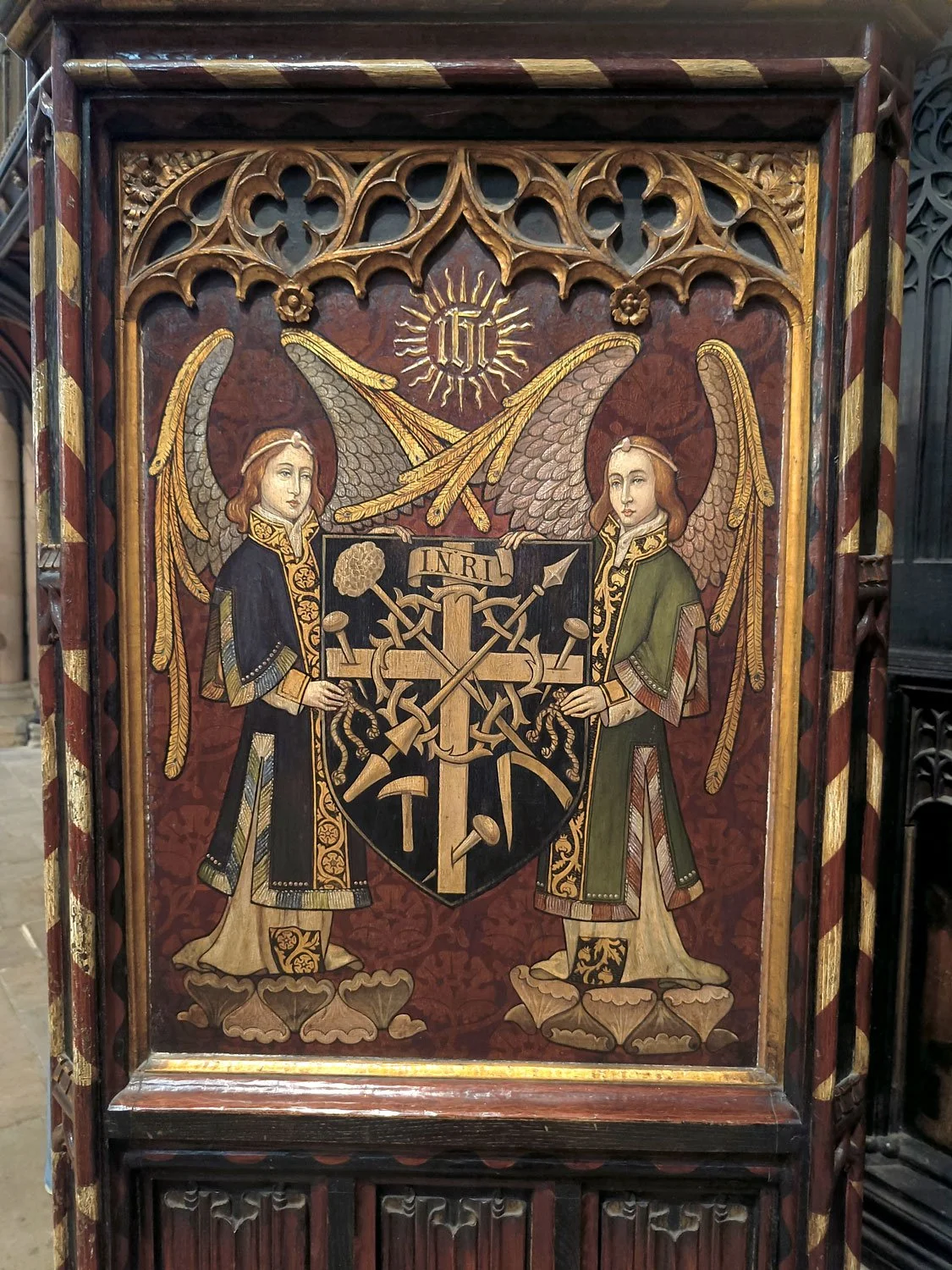
Next up on the tour list was Hexham Abbey. I had been working on a reflective space The Cherubim for St Mary’s Episcopal Cathedral (which is now installed and can be experienced until 30 October, more info here), so I am currently fascinated by other artists’ work depicting angels and their wings. The Hexham Abbey pulpit has this beautiful image of angels holding up a shield with elements of the crucifixion of Jesus with the letters INRI. I found out INRI sounds for Iesus Nazarenus Rex Iudaeorum, translated as ‘Jesus of Nazareth, King of the Jews’.
Walking up the ‘night stairs’ (stairs which the canons/monks used to come down from their dormitories each night and say prayers in the cathedral), I sighted some more paintings of angels. This time, two of them were depicted as playing instruments. Hexham Abbey records these as being part of an angel choir painted by artists Messrs. Chas. Head & Son c. 1911 (the same age as the pulpit it seems).
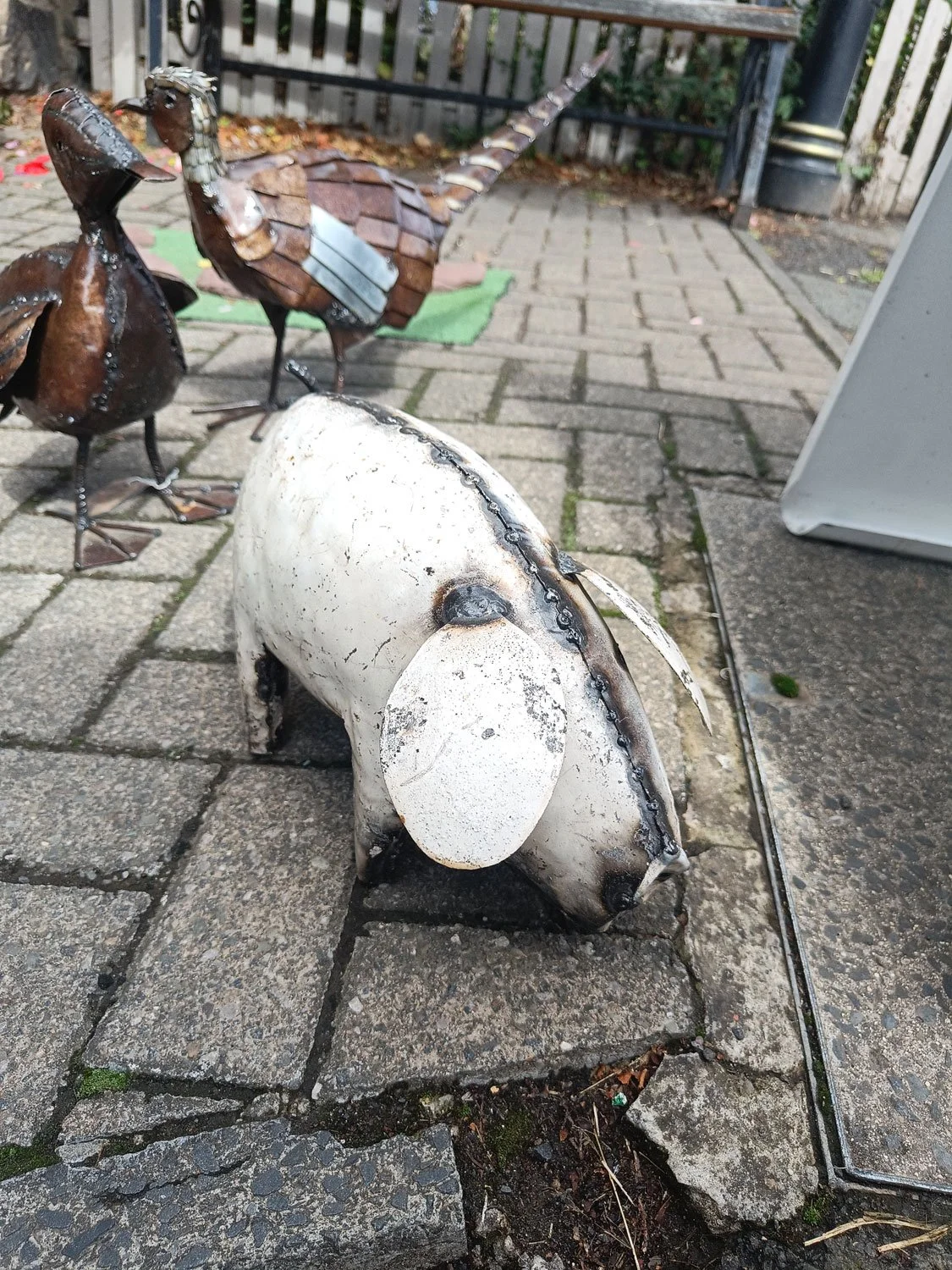
Metal garden pig
Of course a visit to the Hexham Abbey shop was in order. Of all the things, the metal garden pigs were my favourite! I had seen one also at the Craft Works Gallery of Corbridge. If only I would have had room in my backpack, I would have bought one and taken it on the train. Unfortunately, I haven’t been able to find out who makes them, but if it’s you, they are so super cool, thank you! I love the industrial nature of them; the fade in and fade out of white and black and the little piggy expressions.
Corbridge by the way had a wonderful array of lovely shops with lots of goodies. I thought all the shops were beautifully set out and everything in Corbridge in such neat order, it left me amazed!
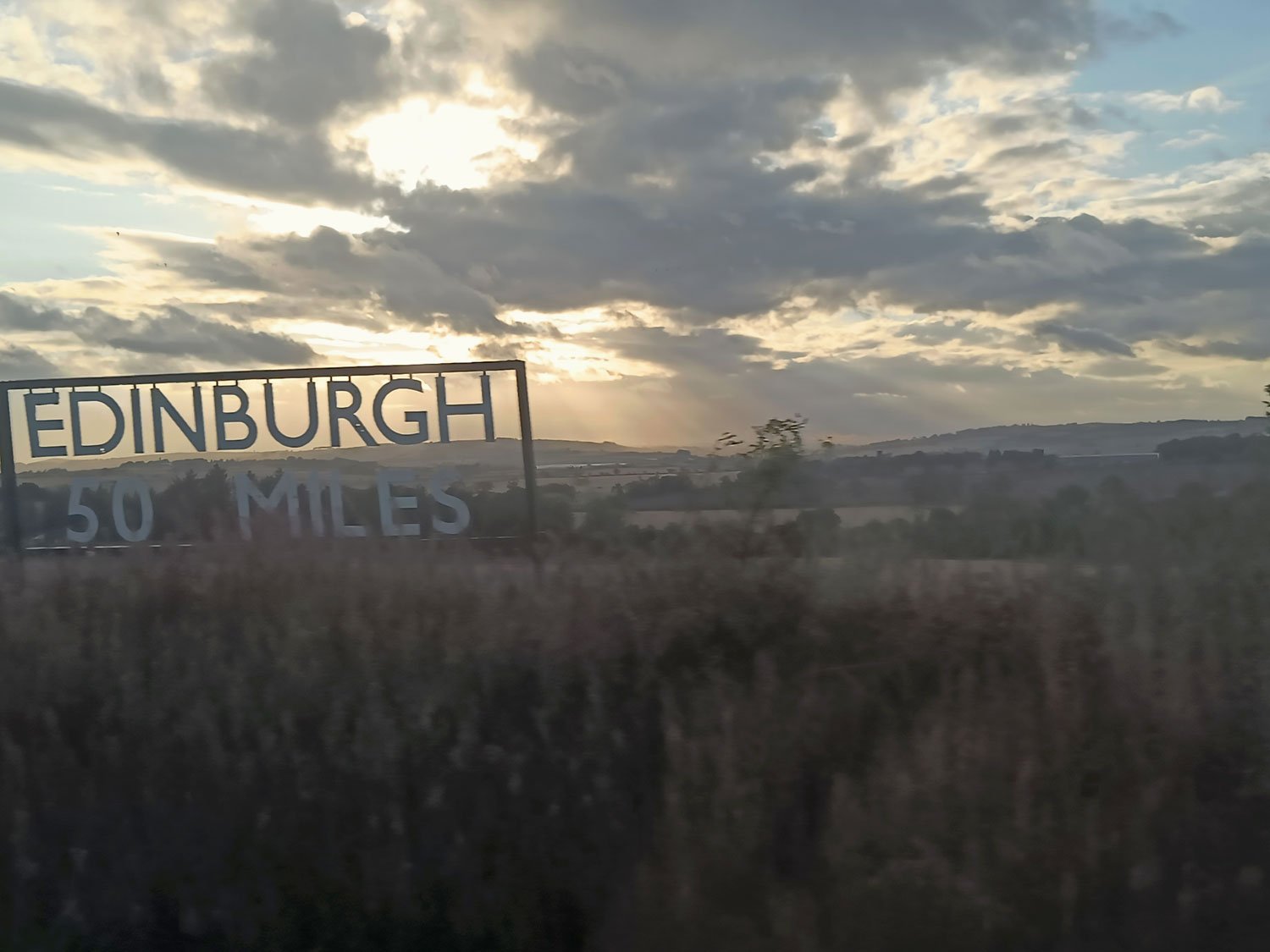
Restored Lineside Sign - Edinburgh 50 miles
On the way back on the train from Northumberland to Edinburgh, trying to get more photos of sunlit golden hay bales, I didn’t realise I snapped this photo of the original LNER Edinburgh 50 mile sign. I think some of these were restored in partnership with the Railway Heritage Trust and volunteers from Network Rail, based on this Transform Scotland archive post. I am quite chuffed with this accidental shot. The sign is situated perfectly so that the ‘Edinburgh’ looks like it is perched on top of the hill in the distance.
While writing this travel journal, I’ve been listening to the K + C Dramas playlist I’ve created, which brings back so many memories of all the K + C dramas I’ve watched so far. It’s difficult to pick a favourite song as there are so many good ones. My top three tear jerkers in no order would be Here I am by Jo Hyun Ah from my favourite K drama of all time Mr Queen; Love Will Restore by Ye Huai Pei (Andrew Yeh) from C drama Ice Fantasy and Can You See My Heart by Heize from K drama Hotel del Luna (this drama made me so sad because of the tragic story about her first love). For more recent K dramas, Home by Woody from Boyfriend on Demand is a beautiful song and the upbeat I find you by Doyoung from Bon Appétit, Your Majesty makes me want to dance and swirl about the room! The Original Soundtrack from Dynamite Kiss (Dynamite Kis-sa ;-)) also has a lot of great tunes, including Always and Kiss Run. I feel Sleepless from Sold Out on You by Jung Seung Kwan is the perfect song for watching the rain fall on a grey afternoon. Sold Out on You also has this great scene where Kang Mu-Won sees Moon Ae-ra icing cupcakes in her cafe with her headphones on and the look on his face pretty much says he totally falls for her at this moment. The R&B and jazz pop song Fairy of Shampoo by Light and Salt is just perfect for this moment and would probably be the coolest song I’ve come across in a K drama. When a Chinese friend of mine got married years ago, I couldn’t understand why Asian karaoke tunes filled the night, but now I do!